Software Documentation That Actually Ships With the Product
Documentation should capture decisions, constraints, and operating knowledge without slowing the engineering team down.
Software Documentation That Ships With the Product
Software documentation is often treated as something that happens after the important engineering work is finished.
A feature is implemented, the code is reviewed, the tests pass, and then someone is asked to "write the documentation."
That approach usually produces documentation that is incomplete, difficult to maintain, or disconnected from the way the software actually works.
Useful documentation is not a decorative layer around a product.
It is part of the product's operational infrastructure.
Developers use it to understand systems they did not build. Product teams use it to understand capabilities and limitations. Support teams use it to answer questions. New engineers use it to become productive. Future maintainers use it to understand decisions that no longer seem obvious.
Good documentation therefore has a practical purpose:
It reduces the amount of knowledge that people have to reconstruct from source code, old conversations, and trial and error.
The challenge is not simply writing more documentation.
The challenge is creating documentation that is accurate, discoverable, maintainable, and useful at the moment someone needs it.
Documentation Has Different Jobs
One reason documentation becomes difficult is that different readers need different information.
A developer integrating with an API needs a different document from a new engineer learning the architecture.
A user needs a different explanation from an operations engineer deploying the system.
A useful documentation system therefore separates information by purpose.
Common categories include:
Tutorials
Tutorials help someone learn by completing a practical task.
For example:
Create a project
   ↓
Configure the environment
   ↓
Implement a feature
   ↓
Run it locally
   ↓
Verify the result
Tutorials should be guided and sequential.
They are usually written for someone who does not yet understand the system.
How-to Guides
How-to documentation helps an existing user accomplish a specific task.
Examples include:
- configuring authentication
- adding a new environment
- running a migration
- creating a release
- troubleshooting a common problem
A how-to guide does not need to teach the entire system.
It needs to get the reader from a known starting point to a desired outcome.
Reference Documentation
Reference material describes facts precisely.
Examples include:
- API endpoints
- configuration fields
- command-line options
- database schemas
- environment variables
- supported values
Reference documentation should prioritize completeness and precision.
Explanations
Explanations provide context and reasoning.
Examples include:
- why a system uses a particular architecture
- why a database was selected
- how authentication flows through the application
- why a certain deployment strategy exists
These documents are particularly valuable when the system contains decisions that are not obvious from the code.
Write for the Reader's Immediate Question
A common documentation mistake is beginning with everything the author knows.
That usually produces a long document before the reader reaches the information they actually need.
Instead, start by asking:
What is the reader trying to accomplish?
For example, a developer searching for:
"How do I run the backend locally?"
does not initially need a complete history of the architecture.
They need:
Prerequisites
    ↓
Install dependencies
    ↓
Configure environment
    ↓
Start services
    ↓
Run application
Additional architecture information can be linked afterward.
Documentation becomes more useful when it respects the reader's current context.
Good Documentation Has a Clear Entry Point
A new engineer should not have to open ten unrelated files before understanding where to begin.
A useful documentation structure might look like:
Documentation
├── Getting Started
├── Development
├── Architecture
├── API Reference
├── Deployment
├── Operations
└── Troubleshooting
The exact structure depends on the project.
The principle is that readers should be able to identify where their question belongs.
A good documentation system is navigable before the reader understands the system itself.
The README Should Not Become the Entire Documentation System
A README is often the first thing someone sees.
That makes it valuable.
But it should not become a giant document containing every piece of project knowledge.
A practical README might explain:
- what the project is
- what it contains
- how to start locally
- where the main documentation lives
- basic development commands
- important prerequisites
Detailed topics can live elsewhere.
For example:
README
   ↓
Getting Started
   ↓
Architecture
   ↓
API Reference
   ↓
Operations
This keeps the entry point concise while preserving depth elsewhere.
Document the Setup Path From a Clean Machine
One of the strongest tests of development documentation is simple:
Can another developer follow it on a clean machine?
A setup guide should identify:
- required tools
- supported versions where relevant
- dependencies
- environment configuration
- required services
- database setup
- initial data or migrations
- commands to run the application
- commands to run tests
Avoid assuming that the reader already knows what the author knows.
For example, instead of:
"Start the usual services."
write the actual commands and explain which services are required.
The goal is to remove hidden knowledge.
Explain Environment Variables Carefully
Environment variables are often documented poorly.
A project may contain:
API_URL
DATABASE_URL
AUTH_SECRET
STORAGE_BUCKET
but a new developer may not know:
- which values are required
- which are optional
- where they come from
- which environments use them
- whether they contain secrets
- what happens when they are missing
A useful reference can include:
| Variable | Required | Purpose | Example |
| --- | --- | --- | --- |
| API_URL | Yes | Backend endpoint | https://api.example.com |
| DATABASE_URL | Yes | Database connection | Local development value |
| FEATURE_X | No | Enables feature X | true |
Never publish real secrets in documentation.
Use safe examples and explain where developers obtain the actual values.
Documentation Should Distinguish Configuration From Secrets
This distinction is important.
A configuration value might safely be documented:
APP_ENV=development
A private credential should not be copied into a public repository:
PAYMENT_SECRET=actual-production-secret
Documentation can instead explain:
PAYMENT_SECRET
→ obtain from the production secret manager
This makes the setup process understandable without exposing credentials.
API Documentation Should Describe Behavior
Listing endpoints is not enough.
A useful API reference should answer:
- What does this endpoint do?
- Who can call it?
- What input does it require?
- What does it return?
- What errors can occur?
- Are there pagination rules?
- Does the operation have side effects?
- Is it safe to retry?
For example:
POST /orders/{id}/cancel

Purpose:
Cancels an eligible order.

Authentication:
Required.

Authorization:
The authenticated user must own the order.

Possible results:
200 - cancellation completed
400 - order cannot be cancelled
401 - authentication required
403 - user is not allowed
404 - order not found
409 - order state changed
This is much more useful than a list of endpoint names.
Show Examples, Not Just Definitions
Developers understand interfaces faster when they can see realistic examples.
For an API, include a representative request:
{
  "quantity": 2,
  "shippingAddressId": "addr_123"
}
and response:
{
  "id": "order_123",
  "status": "confirmed"
}
Examples should be realistic but safe.
Do not use production credentials, personal information, or sensitive identifiers.
The goal is to demonstrate shape and behavior.
Explain Failure Cases
Documentation that describes only successful behavior is incomplete.
For important operations, explain:
- validation failures
- authentication failures
- authorization failures
- conflicts
- rate limits
- server errors
- retry behavior
This is particularly important for mobile and web clients because they need to decide how to respond to failures.
For example:
409 Conflict
    ↓
Do not blindly retry
    ↓
Refresh current state
    ↓
Explain the conflict to the user
A client developer should not have to infer this from backend source code.
Document State Transitions
Many systems are easier to understand as state machines.
For example, an order might move through:
Pending
   ↓
Confirmed
   ↓
Processing
   ↓
Completed
with alternative paths:
Pending → Cancelled
Confirmed → Refunded
Documentation should explain:
- valid transitions
- who can trigger them
- what conditions are required
- what side effects occur
This is particularly valuable for:
- payments
- orders
- subscriptions
- authentication
- content publishing
- background jobs
State is often where the most important business rules live.
Architecture Documentation Should Explain Why
A diagram showing:
Mobile
  ↓
API
  ↓
Database
is useful, but incomplete.
A developer also needs to understand why the system is structured that way.
For example:
The API owns authorization and business rules so that mobile and web clients cannot implement conflicting versions of the same rule.
That explanation preserves architectural intent.
Without it, a future developer may "simplify" the system and accidentally remove an important boundary.
Document Important Decisions
Architectural decisions often disappear from memory.
A system may use a particular database, queue, caching strategy, or API structure because of a constraint that no longer appears in the code.
A short decision record can preserve that context.
A useful structure is:
Decision
Context
Options considered
Chosen approach
Reason
Consequences
For example:
Decision:
Use cursor-based pagination for transaction history.

Context:
The dataset changes frequently and users can load many pages.

Reason:
Cursor pagination provides more stable continuation behavior
when new records are inserted.

Consequence:
The client must persist and send continuation information.
This is much more useful than simply writing:
"We use cursor pagination."
Document Constraints, Not Just Capabilities
Developers often document what a system can do.
They should also document what it cannot safely do.
Examples:
- an endpoint cannot be called more than once without an idempotency key
- a field cannot be changed after confirmation
- a migration must run before a deployment
- a service requires a particular database extension
- a feature is unavailable offline
- a webhook may arrive more than once
Constraints are often more important during maintenance than the happy path.
Keep Operational Documentation Close to the System
Deployment and operations knowledge should not exist only in private messages.
Useful operational documentation can include:
- how to deploy
- how to roll back
- how to run migrations
- how to inspect logs
- how to restart a worker
- how to verify service health
- how to handle common incidents
A production system should be operable by someone who did not personally build every component.
That is one of the strongest tests of documentation quality.
Write a Troubleshooting Guide From Real Failures
Troubleshooting documentation is most valuable when it comes from actual problems.
For example:
Problem:
Application cannot connect to local backend.

Check:
1. Backend process is running.
2. API URL points to the correct environment.
3. Required environment variables exist.
4. Database is available.
5. Local firewall/network configuration is correct.
Another:
Problem:
Migration fails during startup.

Check:
1. Current schema version.
2. Previous migration status.
3. Database connectivity.
4. Migration ordering.
5. Application version compatibility.
These guides become more useful over time because they capture operational knowledge that would otherwise be repeatedly rediscovered.
Documentation Should Evolve With Code
Documentation becomes unreliable when it is written once and forgotten.
A useful rule is:
If a code change changes how someone uses, deploys, integrates with, or maintains the system, the corresponding documentation should be reviewed in the same change.
For example:
Change API response
    ↓
Update API reference

Change environment variable
    ↓
Update configuration docs

Change deployment process
    ↓
Update operations guide

Change architecture
    ↓
Update architecture explanation
Documentation should therefore be part of the definition of done for changes that affect documented behavior.
Treat Documentation as Code
Documentation benefits from many of the same engineering practices as source code.
Use:
- version control
- pull requests
- review
- clear ownership
- automated checks
- link validation
- examples that can be tested
- regular maintenance
This changes documentation from an informal activity into a maintainable engineering asset.
It also creates a useful workflow:
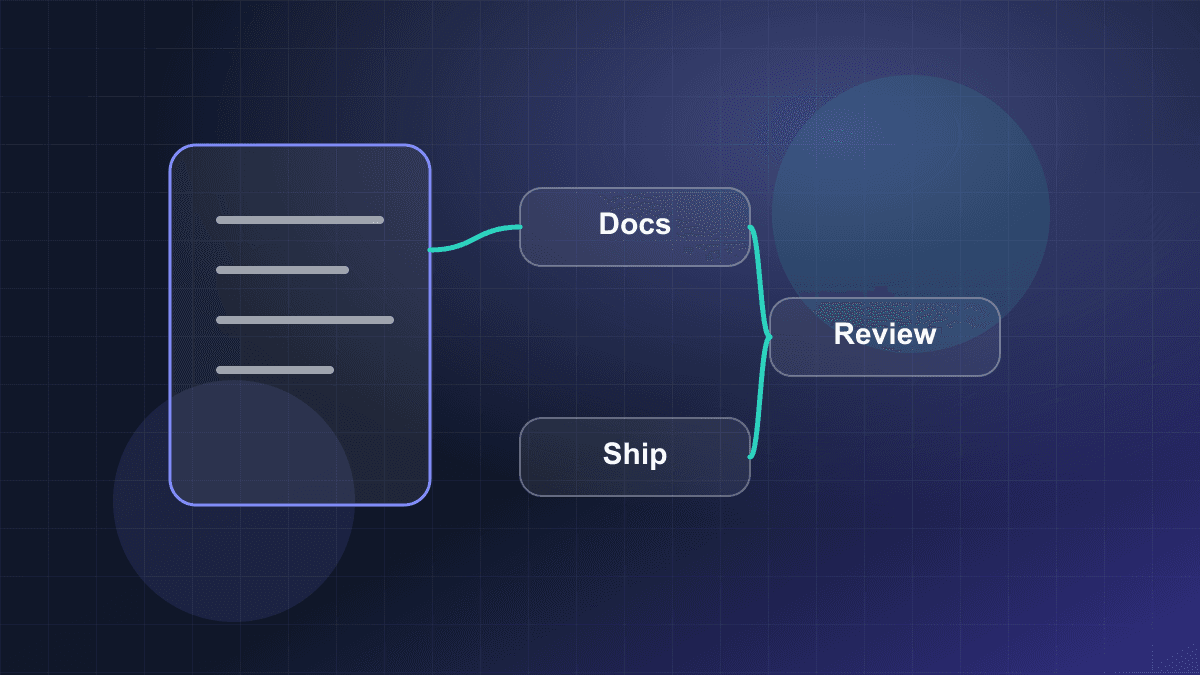
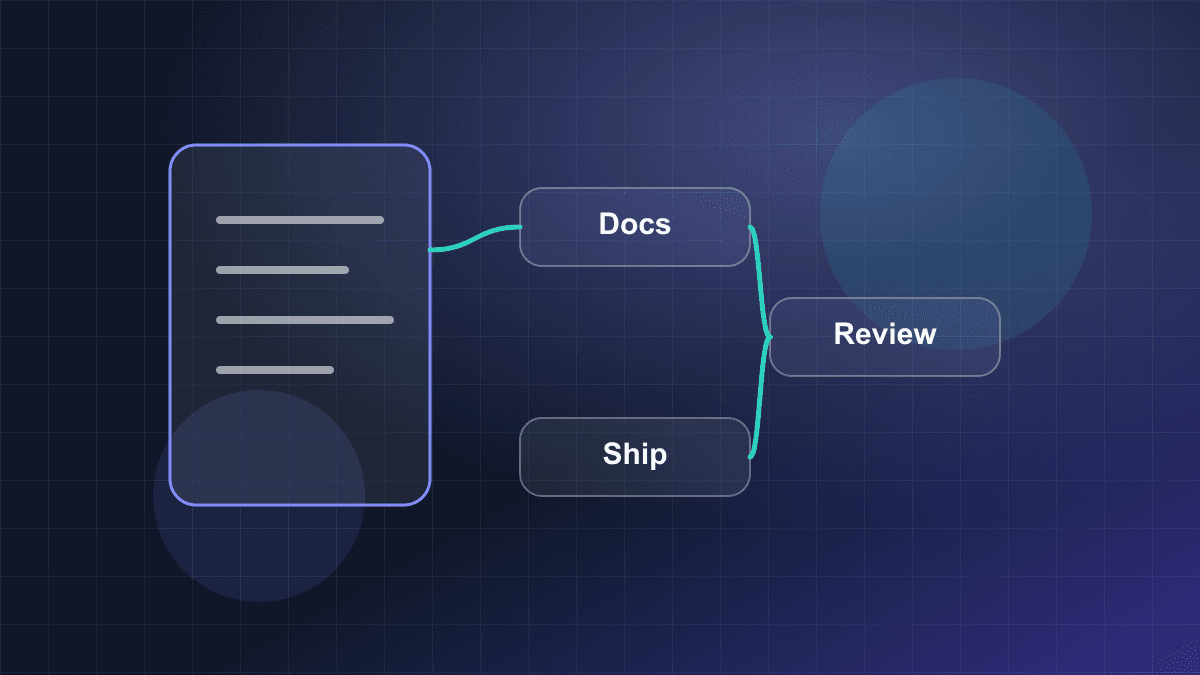
Code change
   ↓
Documentation change
   ↓
Review
   ↓
Merge
   ↓
Publish
The exact tooling can vary, but the principle remains.
Avoid Documentation That Duplicates Source Code
Not everything needs to be written twice.
For example, copying an entire class definition into documentation creates a maintenance problem.
When source code is the authoritative reference, documentation should explain:
- what the component does
- why it exists
- how it should be used
- important constraints
- examples
- common mistakes
Reference information can be generated automatically when appropriate.
The goal is to avoid creating two independently maintained copies of the same truth.
Generated Documentation Can Help
Some documentation is especially suitable for generation.
Examples include:
- API schemas
- endpoint references
- configuration references
- type definitions
- command references
Generation can reduce duplication.
But generated documentation does not eliminate the need for human-written explanations.
A generated API schema can tell you that a field exists.
It may not explain why the field should not be used in a particular workflow.
Automation and explanation serve different purposes.
Documentation Needs Ownership
A documentation system without ownership gradually becomes stale.
Ownership does not mean one person writes everything.
It means someone is responsible for making sure important documentation has a maintenance path.
Ownership can be organized by:
- team
- subsystem
- feature
- document type
For example:
Mobile team
→ Mobile development docs

Backend team
→ API and architecture docs

Platform team
→ Deployment and infrastructure docs
The exact organization depends on the team.
The important part is that "someone should update this" becomes an actual responsibility.
Searchability Is Part of Documentation Quality
Documentation that exists but cannot be found is almost as problematic as documentation that does not exist.
Useful documentation systems provide:
- clear navigation
- descriptive titles
- predictable terminology
- internal links
- search
- related topics
Think about how someone will search for the information.
If the document is titled:
"Authentication Considerations"
but developers search for:
"refresh token"
the document may be difficult to discover.
Titles and headings should reflect the language readers are likely to use.
Link Related Information
A good documentation page should not attempt to contain the entire system.
Instead, connect related concepts.
For example:
Authentication guide
       ↓
Session lifecycle
       ↓
Authorization
       ↓
API authentication reference
       ↓
Troubleshooting authentication
This allows a reader to go deeper when necessary without making every page enormous.
Links also help preserve the relationships between documents.
Avoid Dead Ends
A documentation page should ideally answer:
What should I do next?
A setup guide might end with:
Now run the application.

Next:
→ Read the architecture overview
→ Run the test suite
→ Create your first feature
An API reference might link to:
Authentication
Pagination
Error handling
Rate limits
This creates a navigable learning path rather than a collection of isolated pages.
Examples Should Be Maintained
Examples are powerful because developers copy them.
That also makes stale examples dangerous.
An outdated example can be worse than no example because it looks authoritative.
Examples should therefore be reviewed when:
- APIs change
- configuration changes
- commands change
- authentication changes
- SDK versions change
If possible, important examples should be executable or validated automatically.
The closer an example is to a tested artifact, the less likely it is to silently drift.
Documentation Quality Is About Accuracy
Beautiful documentation is not useful if it is wrong.
A practical review should ask:
- Is the command still valid?
- Does the endpoint still exist?
- Are the parameters correct?
- Are the environment variables current?
- Does the architecture description match the implementation?
- Are screenshots still representative?
- Do internal links work?
Accuracy should generally come before presentation.
A short accurate document is more valuable than a polished but obsolete one.
Avoid Explaining Every Implementation Detail
Documentation can become difficult to maintain when it describes details that change frequently without affecting users.
For example, documenting every private helper function may create significant maintenance work.
Instead, focus on stable concepts:
- public behavior
- responsibilities
- interfaces
- constraints
- important decisions
- operational procedures
Implementation details should be documented when they matter for maintenance or correctness.
The goal is not maximum documentation.
It is maximum useful knowledge.
Documentation Should Help New Engineers Become Productive
A new engineer often needs to answer a sequence of questions:
What is this product?
        ↓
How is the repository organized?
        ↓
How do I run it?
        ↓
How does the architecture work?
        ↓
Where should I make this change?
        ↓
How do I test it?
        ↓
How do I release it?
If documentation answers these questions clearly, onboarding becomes much faster.
This is one of the strongest returns documentation provides to an engineering organization.
It reduces the amount of time experienced engineers spend answering the same questions repeatedly.
Documentation Also Preserves Institutional Knowledge
Teams change.
People move between projects.
Engineers leave.
Responsibilities shift.
Without documentation, important architectural knowledge disappears with the people who originally made the decisions.
Documentation preserves context such as:
- why a system exists
- why a particular trade-off was accepted
- which constraints shaped the architecture
- which failures have already happened
- which operational procedures are important
This is particularly valuable for systems that will be maintained for years.
Review Documentation Like Code
Documentation reviews should ask different questions from code reviews, but they should still be rigorous.
Review for:
Correctness
Does the document describe the system accurately?
Completeness
Does it cover the information required for the stated task?
Clarity
Can the intended reader understand it without unnecessary background?
Discoverability
Can someone find it when searching for the problem?
Maintainability
Will the document remain reasonable to update?
Safety
Does it accidentally expose secrets or sensitive information?
This turns documentation review into a concrete engineering activity.
A Practical Documentation Workflow
A sustainable documentation workflow can be:
Identify reader
      ↓
Identify task
      ↓
Choose document type
      ↓
Write minimum useful path
      ↓
Add examples and failure cases
      ↓
Link related information
      ↓
Review for accuracy
      ↓
Publish with the product change
The important phrase is "minimum useful path."
Start with what the reader needs to succeed.
Then add depth where real questions justify it.
Documentation Checklist
Before publishing an important technical document, check:
Reader
- Is the intended audience clear?
- Does the document begin at the reader's actual starting point?
- Does it avoid assuming unnecessary knowledge?
Task
- Is the goal explicit?
- Can the reader tell what to do next?
- Are commands and examples complete?
Accuracy
- Are names and commands current?
- Are API fields correct?
- Are configuration values current?
- Do links work?
Reliability
- Are failure cases explained?
- Are important constraints documented?
- Are upgrade or migration requirements mentioned where necessary?
Security
- Are secrets excluded?
- Is sensitive information protected?
- Are security boundaries explained correctly?
Maintenance
- Is ownership clear?
- Will the document be reviewed when related code changes?
- Are duplicated facts minimized?
The Most Valuable Documentation Is the Documentation People Use
It is tempting to measure documentation by page count.
That is usually a poor metric.
A better question is:
Did the documentation help someone complete a task without needing additional assistance?
Useful signals can include:
- fewer repeated support questions
- faster onboarding
- fewer setup failures
- fewer integration mistakes
- faster incident resolution
- fewer incorrect assumptions about architecture
Documentation succeeds when it changes how easily people can work with the system.
Conclusion
Good software documentation is not a collection of pages written after the engineering work is complete.
It is part of the engineering system itself.
Tutorials help people learn.
How-to guides help them accomplish specific tasks.
Reference documentation provides precise facts.
Explanations preserve architectural context.
Operational guides make production systems maintainable.
Troubleshooting guides capture lessons from real failures.
The strongest documentation systems connect these different forms of knowledge while keeping each document focused on its purpose.
Most importantly, documentation should evolve with the software.
When an API changes, its documentation should change.
When configuration changes, setup instructions should change.
When architecture changes, the explanation should change.
When a production failure teaches the team something important, that knowledge should have a place to live.
A practical documentation loop is:
Build
  ↓
Document
  ↓
Review
  ↓
Ship
  ↓
Learn
  ↓
Update
The objective is not to document everything.
It is to make important knowledge easy to find, understand, trust, and maintain.
When documentation ships alongside the product, it stops being an afterthought and becomes what it should have been from the beginning: a reliable interface between the software and the people who need to understand, use, operate, and improve it.